Living Water: When Water Gives Life and When We Fail to Care for It Reflections on the 2026 Season of Creation at Don Bosco School of Theology
By Peter John Cumpas, MRS, MaELM
Administrator, Don Bosco School of Theology
LSCET Curriculum Developer, Theocology Pioneer, and Staunch Advocate for Caring for Our Common Home
Every year, Christians around the world celebrate the Season of Creation from September 1 to October 4, a special time dedicated to prayer, reflection, ecological conversion, and concrete action for the care of our common home. It begins with the World Day of Prayer for the Care of Creation and concludes on October 4, the Feast of St. Francis of Assisi, patron saint of ecology. The Season of Creation is an ecumenical celebration that brings Christians of different traditions together in a common commitment to respond to the ecological crisis.[1]
For 2026, the theme is “Living Water.” Its biblical inspiration comes from Ezekiel 47:1–12, where the prophet encounters a river flowing from the temple. The waters grow deeper as they flow, bringing healing to barren land, reviving the waters, and sustaining life. The official Season of Creation materials describe the 2026 symbol as “Immersion in Living Water,” inviting Christians not merely to admire creation but to immerse themselves in God’s work of renewing it.[1]
The theme is particularly meaningful for us in the Philippines. We are a nation surrounded by water, dependent upon it for life and livelihood, and yet increasingly vulnerable to the destructive effects of flooding and extreme rainfall. At the same time, our rivers, seas, waterways, and other sources of water are being threatened by the very waste and pollution that we ourselves produce.
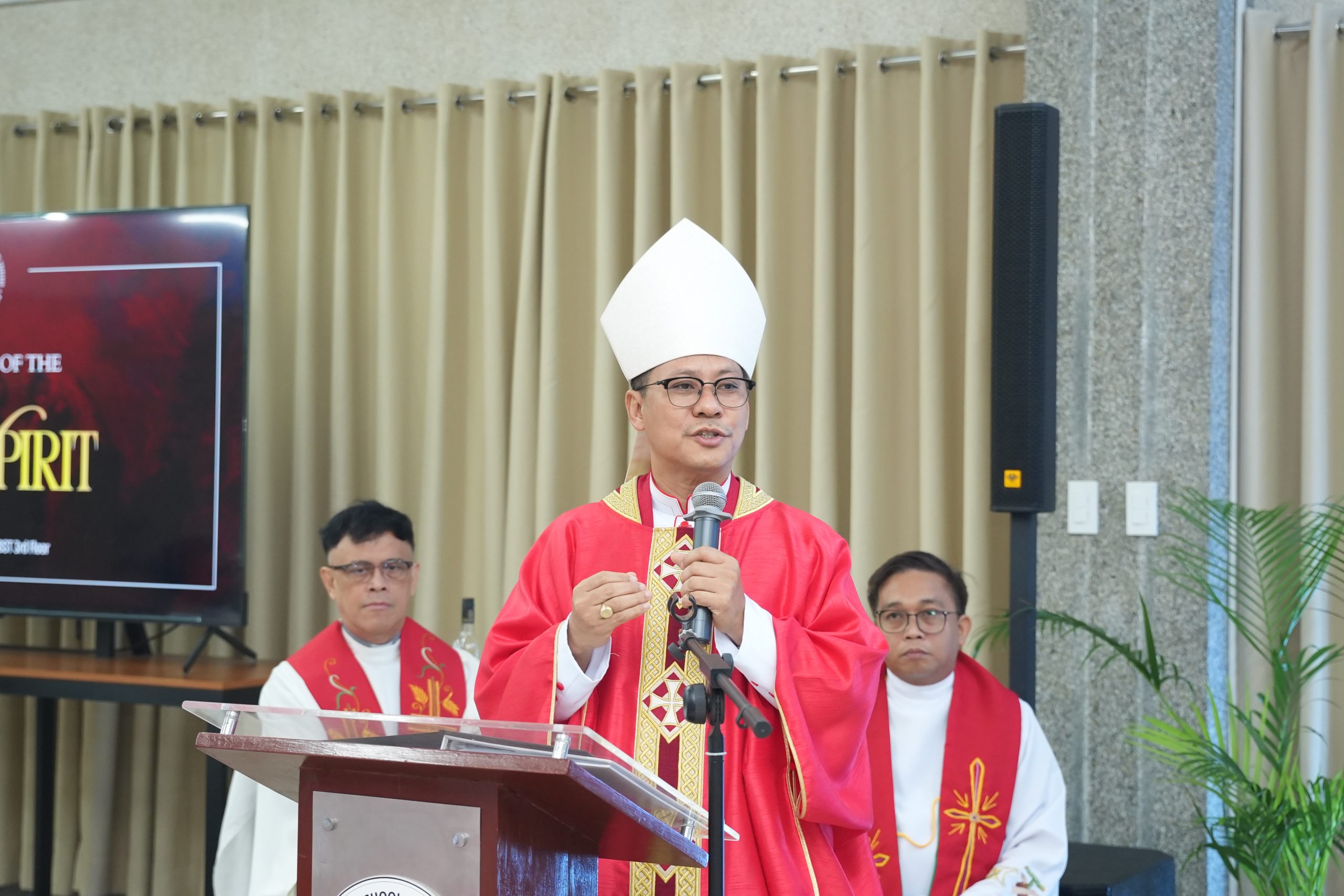
It was against this backdrop that Don Bosco School of Theology opened its celebration of the Season of Creation with a Creation Mass with the staff, presided over by Fr. Francis Gustilo, President of Don Bosco School of Theology.
Water as a Gift of Life
In his homily, Fr. Francis invited the community to reflect on the fundamental importance of water. Water is one of the most basic conditions for life. We drink it, cook with it, use it for sanitation, grow our food with it, and depend upon it for countless aspects of our daily existence. Creation itself bears witness to the generosity of God through water.
Yet Fr. Francis also drew attention to the other face of water. Water can give life, but water can also cause suffering and destruction. His reflection was particularly poignant in the context of the rains brought by the Southwest Monsoon or Habagat, which have affected communities throughout the Philippines.
The experience of recent weeks makes this reality painfully concrete. According to the National Disaster Risk Reduction and Management Council’s Situational Report No. 37, issued on September 9, 2026, the combined effects of the enhanced Southwest Monsoon and Tropical Cyclones Luis, Maymay, Neneng, and Pilandok had affected 9,614,020 people, or 2,781,245 families, across ten regions. The report recorded 44 deaths, 18 injuries, and five people missing, while 162,057 people had been displaced and were staying in evacuation centers.[2]
The same report recorded 1,830 flooded areas and 79 other related incidents, including rain-induced landslides, collapsed structures, and destructive winds. It also reported damage to 4,361 houses. Damage to infrastructure was estimated at ₱8.30 billion, while agricultural damage reached approximately ₱4.12 billion, affecting 92,953 farmers and fisherfolk and more than 80,000 hectares of crops.[2]
These numbers provide a sobering context for Fr. Francis’ reflection. They remind us that the water that sustains us can also become a source of immense human suffering. Behind the statistics are families whose homes have been flooded, farmers whose crops have been destroyed, workers whose livelihoods have been interrupted, communities that have been displaced, and lives that have been lost.
When Water Becomes a Disaster
Flooding is a natural phenomenon, but the scale and consequences of many extreme rainfall events are increasingly shaped by human activity.
The Intergovernmental Panel on Climate Change (IPCC) has concluded that human influence, particularly greenhouse-gas emissions, is likely the main driver of the observed global-scale intensification of heavy precipitation over land regions. It has also found that human-induced climate change has contributed to the intensification of heavy precipitation over Asia.[3]
The IPCC further reports with high confidence that human-induced climate change increases heavy precipitation associated with tropical cyclones.[4] A warmer atmosphere can hold more moisture, and the IPCC estimates that the atmosphere’s moisture-holding capacity increases by approximately seven percent for every one degree Celsius of warming.[3]
This does not mean that every flood or every rainfall event can simply be attributed to climate change. Weather systems are complex, and flooding is also influenced by geography, land use, drainage systems, deforestation, urbanization, watershed degradation, and other factors.
What climate science does tell us is that human activity is altering the climate system and contributing to conditions in which certain extreme rainfall events can become more intense.[3][4] This gives greater urgency to the Christian call to ecological conversion. If human beings contribute to the conditions that intensify environmental suffering, then human beings must also accept the responsibility to change the way we live.
The Season of Creation therefore cannot be reduced to an annual environmental campaign. It is an invitation to conversion and to recognize that our relationship with creation is also part of our relationship with God.
The Water We Have Is the ONLY Water We Have
One of the most striking insights from Fr. Francis’ homily was his reminder that the water we have is the ONLY water we have.
The water that sustains us is part of the Earth’s continuing water cycle. It moves through the atmosphere, land, rivers, oceans, groundwater, plants, animals, and human communities. We do not have an unlimited new supply that we can simply replace when we have contaminated what is available.
And yet, humanity continues to pollute the very water upon which life depends.
The Philippines illustrates this contradiction painfully. The World Bank estimates that the country generates approximately 2.7 million tonnes of plastic waste every year, with an estimated 20 percent ending up in the ocean. It also estimates that Filipinos consume around 163 million plastic sachets every day.[5]
A more recent World Bank assessment estimates that the Philippines generates around 1.7 million tonnes of post-consumer plastic waste annually and leaks more than 300,000 tonnes of plastic waste into marine ecosystems every year. The assessment also estimates that nearly 164 million plastic sachets and almost 48 million plastic shopping bags are used every day in the country. Much of this mismanaged plastic ends up in landfills, open dumpsites, waterways, and eventually the ocean.[6]
These figures are disturbing precisely because water does not disappear when we pollute it. It continues through the Earth’s water systems while carrying the consequences of our actions.
When garbage clogs drainage systems, heavy rain can become flooding. When waterways are treated as dumping grounds, their capacity to carry water is compromised. When rivers and seas become repositories for plastic and other pollutants, we damage ecosystems that are essential not only to biodiversity but also to human communities.
The water itself is not our enemy. Our failure to care for the systems that sustain water can become part of the problem.
A Crisis We Have Seen Before
The experience of 2026 should also be understood within the broader pattern of disasters experienced by the Philippines.
In 2025, the combined effects of the Southwest Monsoon and Tropical Cyclones Crising, Dante, and Emong affected 7,457,942 people, according to the NDRRMC. More than 37,000 houses were damaged, while agricultural damage was initially estimated at ₱1.96 billion and infrastructure damage at ₱9.5 billion.[7] By August 1, 2025, the official figures had risen to 8,263,199 affected people, with combined agricultural and infrastructure damage reaching approximately ₱12.84 billion.[8]
The experience of 2023 was likewise devastating. The Climate Change Commission’s 2023 Annual Report records that major natural events and disasters affected approximately 12.06 million people in the Philippines. Around 100 people died and 20 remained missing. Total damage from major extreme natural events was estimated at approximately ₱23 billion, including ₱18.1 billion attributed specifically to tropical cyclones.[9]
Interestingly, 2023 also illustrates why simply counting the number of typhoons does not tell the whole story. Only 11 tropical cyclones entered the Philippine Area of Responsibility that year, well below the long-term average of about 20. Yet several systems interacted with the Southwest Monsoon and produced heavy rainfall, floods, and landslides.[9]
The lesson is important. Climate vulnerability is not simply a matter of how many storms enter the country. It is also about how changing climatic conditions interact with human settlements, ecosystems, infrastructure, and communities.
These figures do not prove that every disaster is directly caused by climate change. They do, however, reveal the extraordinary vulnerability of our communities and the enormous human and economic cost of extreme weather.
They also remind us that ecological care is not an abstract concern for future generations. It is already a question of human life, human dignity, livelihood, and survival.
From Water to Living Water
The Christian response, however, cannot end with fear.
The Season of Creation does not invite us simply to contemplate a wounded planet. It invites us to hope and to act.
This is where the theme “Living Water” becomes profoundly Christian.
In the Gospel of John, Jesus meets the Samaritan woman at the well and speaks of water that reaches beyond physical thirst. He tells her that the water he gives becomes a spring of water welling up to eternal life (John 4:14).
The Christian understanding of water therefore moves from creation to Creator, from the physical gift to its deepest spiritual meaning.
Jesus is the Living Water.
And if we truly receive that Living Water, then it must change how we live.
We cannot claim to drink from the Living Water of Christ while remaining indifferent to the waters of creation that sustain our brothers and sisters. We cannot separate love of God from responsibility toward the world God has entrusted to us. Ecological conversion begins when we recognize that creation is not simply a collection of resources available for our use but a gift through which we encounter the generosity of the Creator.
The river in Ezekiel’s vision flows outward and brings life wherever it goes. The same must be true of the Christian who encounters Christ. The Living Water received from Christ cannot remain contained within us. It must flow outward in the way we live, consume, work, teach, build communities, and care for the vulnerable.
Immersed in Living Water
Perhaps this is the most beautiful invitation of the 2026 Season of Creation.
We are not merely asked to look at Living Water. We are invited to immerse ourselves in it.
To immerse ourselves means allowing our faith to enter into the concrete realities of our world: the family affected by flooding, the farmer whose crops have been destroyed, the community whose river has become polluted, the child growing up amid increasing environmental uncertainty, and the countless people whose lives are made more vulnerable by ecological degradation.
It also means looking honestly at our own habits and asking whether the way we live contributes to the healing or the wounding of our common home.
The water that falls from the sky is a gift. The rivers that carry it are a gift. The seas that sustain life are a gift. The water that reaches our homes is a gift.
But a gift also carries responsibility.
The Season of Creation calls us to recover that sense of wonder and responsibility. It reminds us that we are not masters of creation but stewards within it, entrusted with something that belongs ultimately to God.
This year, as we hear the rain fall and watch the waters rise, perhaps we can hear a deeper invitation beneath the sound. The water asks us to remember where life comes from. The floods remind us of our vulnerability. Polluted rivers confront us with our responsibility. And the Living Water of Christ reminds us that creation can still be renewed when human hearts are converted and when our actions begin to flow from love rather than consumption.
May this Season of Creation lead us deeper into that Living Water. May the water that flows from God’s heart renew not only the rivers and seas of our wounded planet, but also our own hearts, our communities, and our way of living.
And may what we receive from Christ never stop with us.
May the Living Water flow through us, into the world, into our communities, and into the future we are called to protect.
Endnotes
- Season of Creation, “Season of Creation 2026: Living Water,” Season of Creation Ecumenical Steering Committee, 2026. The official materials identify Living Water as the 2026 theme, draw the biblical text from Ezekiel 47:1–12, identify the symbol as “Immersion in Living Water,” and describe the Season of Creation as September 1–October 4.
- National Disaster Risk Reduction and Management Council (NDRRMC), Situational Report No. 37: Effects of Southwest Monsoon and Tropical Cyclones Luis, Maymay, Neneng and Pilandok, September 9, 2026. The figures cited in this article are reported by the NDRRMC and reproduced in contemporary reporting by GMA News.
- Intergovernmental Panel on Climate Change (IPCC), Climate Change 2021: The Physical Science Basis, Working Group I, Chapter 11, “Weather and Climate Extreme Events in a Changing Climate.” The IPCC assesses that human influence, particularly greenhouse-gas emissions, is likely the main driver of the observed global-scale intensification of heavy precipitation over land regions and that human-induced climate change has contributed to intensification over Asia.
- Intergovernmental Panel on Climate Change (IPCC), Climate Change 2021: The Physical Science Basis, Working Group I, Summary for Policymakers. The IPCC states with high confidence that human-induced climate change increases heavy precipitation associated with tropical cyclones.
- World Bank, Market Study for Philippines: Plastics Circularity Opportunities and Barriers, World Bank, 2021/2022. The World Bank reports that approximately 2.7 million tonnes of plastic waste are generated annually in the Philippines, with an estimated 20 percent reaching the ocean, and that approximately 163 million plastic sachets are consumed daily.
- World Bank, Plastic Waste in the Philippines, 2026. The report estimates approximately 1.7 million tonnes of post-consumer plastic waste annually, more than 0.3 million tonnes leaking into marine ecosystems each year, nearly 164 million sachets used daily, and almost 48 million shopping bags used daily.
- Philippine News Agency, “Families affected by severe weather conditions breach 2-M mark,” July 2025, reporting the National Disaster Risk Reduction and Management Council’s figures for the combined effects of Habagat and Tropical Cyclones Crising, Dante, and Emong.
- Philippine News Agency, “Agri, infra damage from severe weather reaches P12.8-B – NDRRMC,” August 1, 2025. The report cites NDRRMC figures of 8,263,199 affected persons and ₱12.84 billion in combined agricultural and infrastructure damage.
- Climate Change Commission, Republic of the Philippines, 2023 Annual Report, section on “Loss and Damage in the Philippines.” The report records approximately 12.06 million people affected by major natural events and disasters in 2023, 100 deaths, 20 missing persons, and approximately ₱23 billion in total damage. It also records 11 tropical cyclones entering the Philippine Area of Responsibility and describes several instances in which tropical cyclones interacted with the Southwest Monsoon to produce heavy rainfall and flooding.
References
- Climate Change Commission, Republic of the Philippines. 2023 Annual Report. Manila: Climate Change Commission, 2024.
- Intergovernmental Panel on Climate Change. Climate Change 2021: The Physical Science Basis. Working Group I Contribution to the Sixth Assessment Report. Chapter 11: “Weather and Climate Extreme Events in a Changing Climate.” Cambridge University Press, 2021.
- Intergovernmental Panel on Climate Change. Climate Change 2021: The Physical Science Basis. Summary for Policymakers. Working Group I Contribution to the Sixth Assessment Report. Cambridge University Press, 2021.
- National Disaster Risk Reduction and Management Council. Situational Report No. 37: Effects of Southwest Monsoon and Tropical Cyclones Luis, Maymay, Neneng and Pilandok. September 9, 2026. Reported in GMA News.
- Philippine News Agency. “Agri, infra damage from severe weather reaches P12.8-B – NDRRMC.” August 1, 2025.
- Philippine News Agency. “Families affected by severe weather conditions breach 2-M mark.” July 2025.
- Season of Creation Ecumenical Steering Committee. “Season of Creation 2026: Living Water.” 2026.
- World Bank. Market Study for Philippines: Plastics Circularity Opportunities and Barriers. Washington, D.C.: World Bank.
- World Bank. Plastic Waste in the Philippines. 2026.